Oklahoma Deed Theft: Steps to Help Protect Your Home
Most homeowners have never heard of deed theft until it lands on someone they know. It works like this. A criminal picks a property, forges the owner's signature on a deed, and records that deed at the County Clerk's office. On paper, the property now belongs to someone else. From there the criminal can try to sell it, borrow against it, or rent it out, and the real owner may not find out for months.
Oklahoma law defines deed theft as intentionally altering, falsifying, forging, or misrepresenting a document relating to real property with the intent to deceive, defraud, or unlawfully transfer or encumber the ownership rights of the owner. It also includes someone misrepresenting themselves as the owner or as the representative of the owner to obtain ownership or possession of the property.
That is why speed matters. Once a fraudulent deed is recorded, clearing your title can be difficult, time consuming, and costly.
The good news is that Oklahoma has moved on this. Senate Bill 925 took effect November 1, 2025 and made title theft its own felony crime, punishable by up to 10 years in prison, fines up to $5,000, and restitution to the victim. The same law gave victims a direct tool, which we will get to below. Oklahoma also tightened notary rules, since a fake notary stamp is part of how most of these forged deeds get recorded.
It just happened here in Oklahoma County
In October 2026, News 9 reported that a 29 year old man was arrested after trying three separate times to file fraudulent paperwork claiming ownership of a $5.4 million home near North MacArthur Boulevard and West Memorial Road in Oklahoma City. Oklahoma County Sheriff Tommie Johnson III said the first attempt was reported on September 11, when employees at the County Clerk's office spotted the suspicious filing and called deputies.
Watch how the real owner found out, because every one of these is a warning sign any homeowner can watch for.
The homeowners association called to say someone had tried to get into the gated community claiming he had inherited the property. Mail started arriving at the home addressed to the suspect. The electric service at the home had been transferred into the suspect's name. A lender called the owner about a loan against the house that the owner never applied for.
The owner filed a Notice of Fraudulent Conveyance with the Clerk's office that same day, the exact tool Oklahoma created in the new law, and the suspicious filings were flagged before a fraudulent deed could be recorded. The suspect was later charged with forgery and attempting to obtain property through deception. Case details: News 9, October 22, 2026.
That case is the whole lesson in one story. The fraud was stopped because people noticed small, strange things and acted the same day.
Signs to take seriously
1. Mail or notices arrive about loans, mortgages, or utility accounts you did not open.
2. Expected property tax bills or notices stop arriving.
3. Your name is removed from public property records without your knowledge.
4. A deed, mortgage, or lien appears in public records that you did not sign or authorize.
5. New loans or lines of credit tied to your property appear on your credit report.
6. Unknown people make unexpected offers to buy your property.
Who gets targeted
Criminals look for owners who are least likely to notice a filing quickly. Homes with no mortgage, where the owner holds clear title. Vacant homes and vacant land. Properties owned by someone who lives out of state. Inherited property where the records were never updated. Homes owned by elderly owners living alone.
If any of those describe a property you own, or your parents' home, or land your family has held for years, that property deserves a little extra attention.
You may have already signed the warning
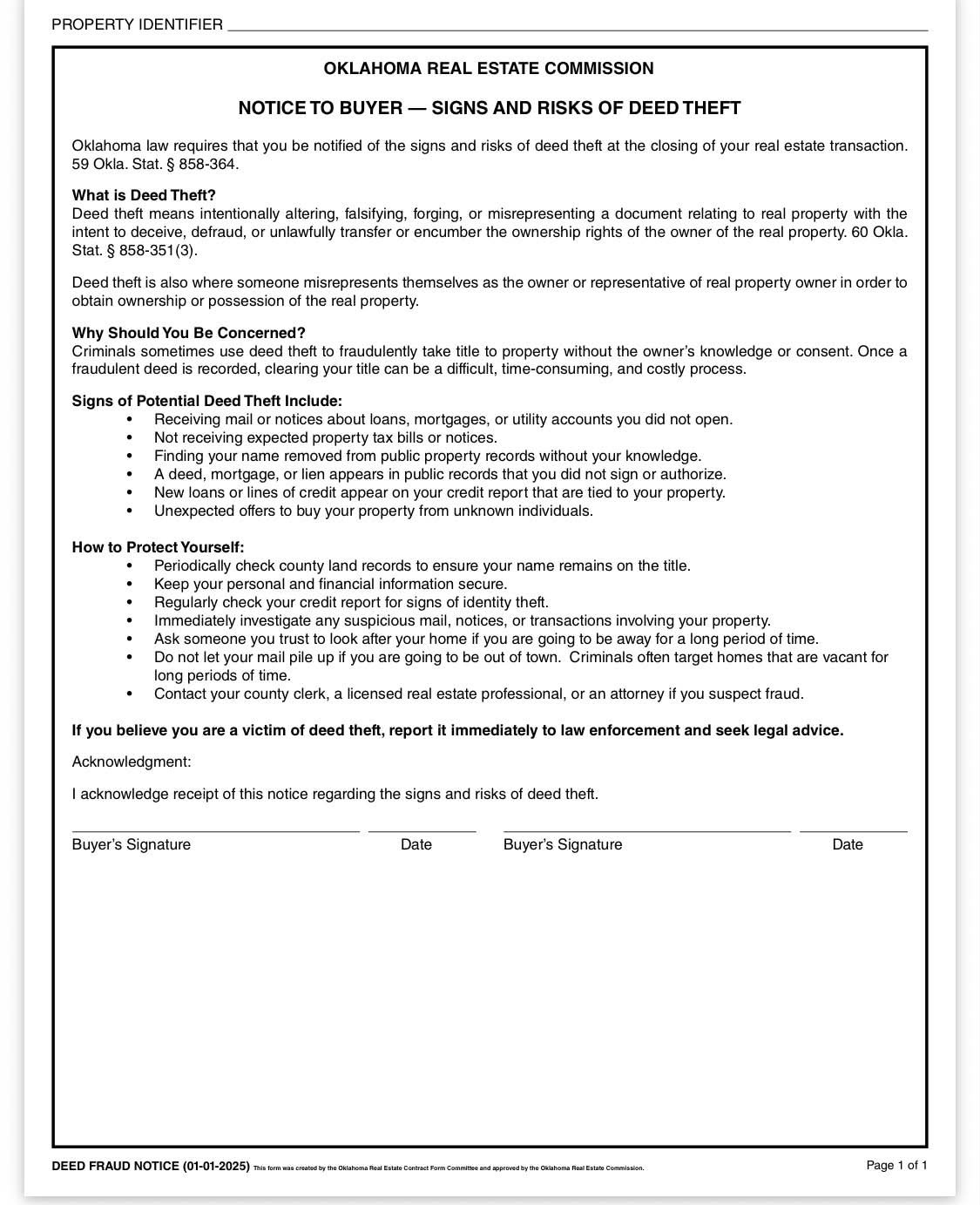
Since January 1, 2025, Oklahoma law requires every buyer to receive the OREC Notice to Buyer on the signs and risks of deed theft at closing. If you bought a home here recently, you signed it, probably in the middle of a stack of paperwork you barely remember. It is worth reading now, before you need it.
The Notice to Buyer on deed theft that Oklahoma law now requires at every closing.
Step 1. Sign up for your county's free property alert
This is the single best step, and it costs nothing. Many Oklahoma County Clerks now run a free notification system that emails you when a document such as a deed or lien is recorded under your name or your property's legal description. It does not block a fraudulent filing, but it tells you right away, and speed is everything in these cases.
Oklahoma County: sign up for the Property Alert System through the County Clerk. Help line is 405-713-1865.
Canadian County: the County Clerk's free notification system sends an email when a deed or lien is recorded with your name, business name, or legal description on file. Call 405-295-6122 or 405-295-6139 to sign up.
Any other county: call your County Clerk and ask one question. Do you offer a free recording notification or property fraud alert? If they do, enroll on the spot.
Two setup tips that matter. Register every version of your name, including a maiden name or a middle initial version. And register each property by its legal description, not just by name, because a filing can be made that never uses your name the way you expect.
Step 2. Check your own record and your credit report
Put a reminder on your calendar and pull your property record through your County Clerk's land records once or twice a year. You are looking for any deed, lien, or filing you do not recognize. Save a copy of what the record shows today so you have a clean baseline to compare against later.
Also check your credit report on a regular basis. A new loan or line of credit tied to your property can be one of the first visible signs that someone is using your information.
Step 3. Keep your tax mailing address current and watch the mail
Your county treasurer and assessor mail goes to the address on file. If a tax statement or an official notice suddenly stops arriving, or mail starts showing someone else's name at your property, treat that as a warning sign and check your record that week. Never throw away official looking mail about your property without opening it.
If you will be away for a long period of time, ask someone you trust to look after your home. Do not let mail pile up while you are out of town. Criminals often target homes that look vacant for long periods of time.
The same goes for the other warning signs from the Oklahoma County case. If your electric or water service is changed out of your name without you asking, if a lender contacts you about a loan you never applied for, or if a neighbor or homeowners association says someone has been asking about your property or claiming they inherited it, do not brush it off. Check your property record, call your County Clerk, and call law enforcement if anything has been filed.
Step 4. Guard your signature and your paperwork
The second kind of deed fraud is not forgery. It is trickery, where an owner is talked into signing a document they do not understand, often pitched as help with payments, a refinance, or saving the home. Read anything before you sign it, and never sign a deed or a quitclaim deed under pressure or on the spot. If someone approaches you about your home or your land and it feels rushed, contact your County Clerk, a licensed real estate professional, or an attorney you already trust before you sign anything.
Step 5. Know what your title insurance covers
If you bought an owner's title insurance policy when you purchased your home, find that paperwork and keep it somewhere you can reach it. Ask your title company what your policy covers if a forged deed is ever filed. It will not stop a filing, but it can matter a great deal when it is time to fix one.
If it happens anyway, move fast
Oklahoma law gives victims a specific first move. A victim of title theft can file a Notice of Fraudulent Conveyance with the County Clerk where the property sits. That filing puts the world on notice that the deed is alleged to be fraudulent, and the clerk is required to send a copy to the District Attorney for investigation.
Alongside that filing, report it immediately to law enforcement and seek legal advice. Get a real estate attorney involved right away. Do not wait, because a property can be sold or borrowed against a second time while the first fraud sits unchallenged.
The bottom line
Deed theft is rare, but it is cheap to guard against. One free county alert signup, one record check a couple of times a year, a regular credit report check, and a healthy suspicion of anyone who wants your signature in a hurry will cover nearly all of the risk.
Our family has owned land here for 100+ years, so we take this one personally. If you want help checking the record on a property you own here in Oklahoma, or you got an alert you do not understand, call us and we will walk through it with you.
Call or text Thad Dobson at 405-255-3302.
Dobson & Co. Real Estate
FAQ
Can someone really steal my house with a forged deed?
They can record a forged deed that makes it look like they own it, then try to sell or borrow against the property. The fraud usually falls apart once challenged, but catching it early makes the fix far easier and cheaper.
Does the county alert prevent deed theft?
No. The alert notifies you after a document is recorded. That early warning is the point, because it lets you act before the property is sold or borrowed against again.
What properties are most at risk?
Homes with no mortgage, vacant homes and land, out of state owners, inherited property with old records, and homes owned by elderly owners living alone.
What is a Notice of Fraudulent Conveyance?
It is an Oklahoma filing, created by the 2025 law, that a title theft victim records with the County Clerk. It flags the deed as alleged fraud in the public record, and the clerk must forward it to the District Attorney.
Photo credit: Photo of the Oklahoma County Courthouse by w_lemay via Wikimedia Commons, CC BY SA 2.0
Read more articles covering real estate trends, helpful advice, and insights for navigating your next move.



With a proven track record of success, a passion for helping clients, and a deep understanding of the Oklahoma real estate market, we are your trusted, local real estate advisors. Whether you're buying your first home, upgrading, downsizing, or investing, we're here to provide you with up-to-date market insights, personalized service, and results-driven strategies.